Why does a 110-acre hilltop get a trail only three-quarters of a mile long? On Elephant Hill, the answer is the property map. Most of the hill is held by an estimated 200 private owners. The new trail, which opened May 2, 2026, runs only across the small share that the Mountains Recreation and Conservation Authority has managed to put under public ownership.
That makes this fall's walk across the hill unusual. You are walking the public portion of Elephant Hill as it stands in 2026. The trail ends at Test Plot, a restoration garden that shows what the hillside could look like once more of it is protected.
What opened, and where
The MRCA announced the trail on May 2 with the Santa Monica Mountains Conservancy and the community group Save Elephant Hill. Elva Yañez, Save Elephant Hill's board president, called it "the first official trail specifically for public use on Elephant Hill in El Sereno." She also pointed out that people have used the MRCA's 10 acres informally for generations.
| Detail | What the sources say |
|---|---|
| Length | About 0.75 mile one way, roughly 1.5 miles out and back |
| West entrance | Corner of Pullman Street and Harriman Avenue |
| East end | Lathrop Street |
| Posted hours | Daily, 7 a.m. to 5 p.m., per LAist's opening coverage |
| Built by | Los Angeles Conservation Corps, with Bellfree Contractors |
| Alignment planned by | Alta Planning and Design, after MRCA community workshops |
| Primary funding | $700,000 grant from the L.A. County Regional Park and Open Space District, Proposition A |
The MRCA's general park rules say sunrise to sunset, which isn't quite the same as the 7-to-5 window LAist published. The hours posted at the gate are the final word.
Why the route bends the way it does
LAist's coverage of the opening quoted Yañez calling the path "a pretty straight shot" that is "kind of twisty and curvy" because of the terrain, with switchbacks "and great views."
The terrain is only part of the reason. According to the MRCA, the alignment was chosen to make the best use of the agency's own land on steep ground. The finished trail stays on MRCA-owned parcels and climbs with switchbacks and drainage features. The MRCA describes the ownership around it as mostly small private parcels, spread across more than 200 non-contiguous holdings.
Here is how much is public so far:
- MRCA parkland: the 10 acres the agency manages, which is the land the trail crosses.
- City of Los Angeles: 15 acres of the undeveloped 110-acre hilltop preserved.
- Recent additions: LAist reported that the MRCA bought 12 more parcels this year, about 2.4 acres in total.
Add those up and roughly a quarter of the hilltop is public, with no single owner holding the rest. Twelve parcels came to about 2.4 acres, so the average parcel is around a fifth of an acre. That is why progress here comes a lot at a time. The MRCA's own release gives two parcel counts for the $700,000 grant. The body text says it funded "four additional parcels," and a quote from the Regional Park and Open Space District's director says "16 additional parcels" are now permanently protected. The figures are never reconciled. In practice, the hill has been coming into public hands in small, uneven pieces.
The work continues. The MRCA got $2.3 million in Proposition 68 grants from the Conservancy in 2025, including money to buy 12 parcels. The Conservancy also gave Save Elephant Hill $200,000 in Proposition 4 funds to build a conservation toolkit for working with property owners.
The walk, west to east
The trail runs one direction and back, so the order of things is worth knowing before you set out.
- Start at Pullman Street and Harriman Avenue. Save Elephant Hill's access guide says parking near the MRCA entrances is limited and asks visitors not to park in front of homes by the Pullman Street stub.
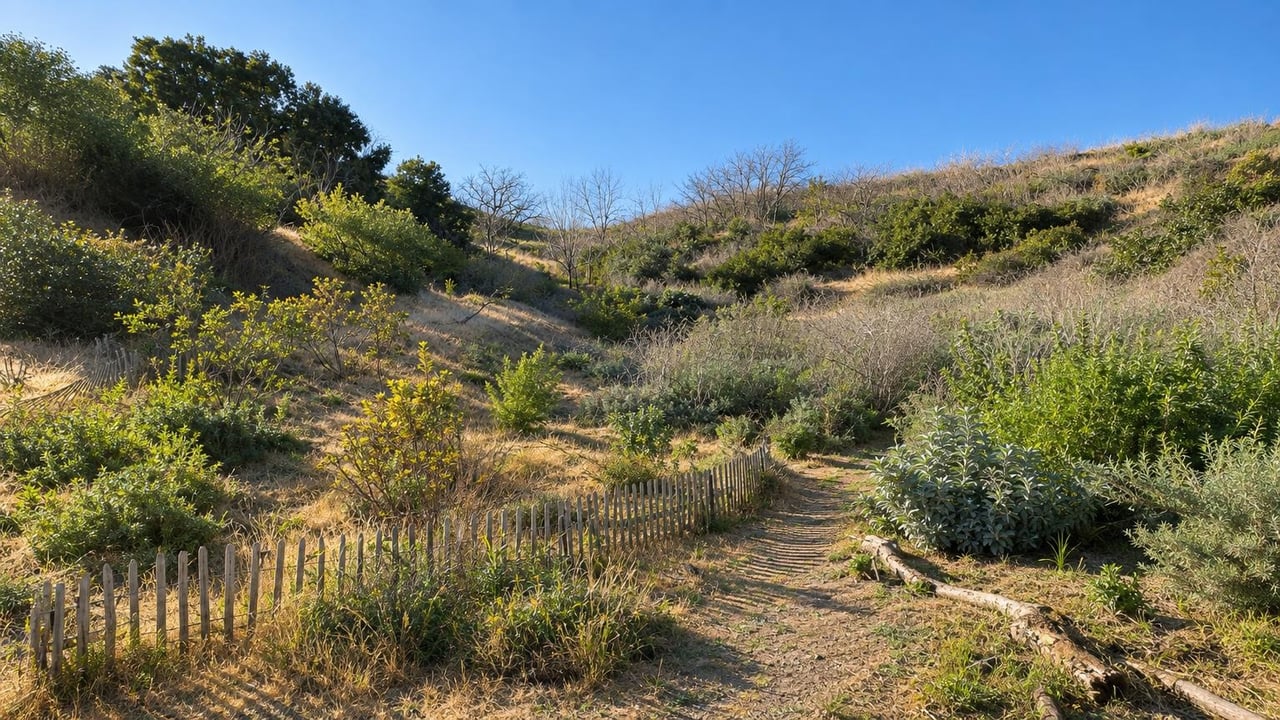
- Climb the switchbacks. Expect trailhead fencing, signage, landscape boulders, and newly planted native trees from the MRCA's build-out.
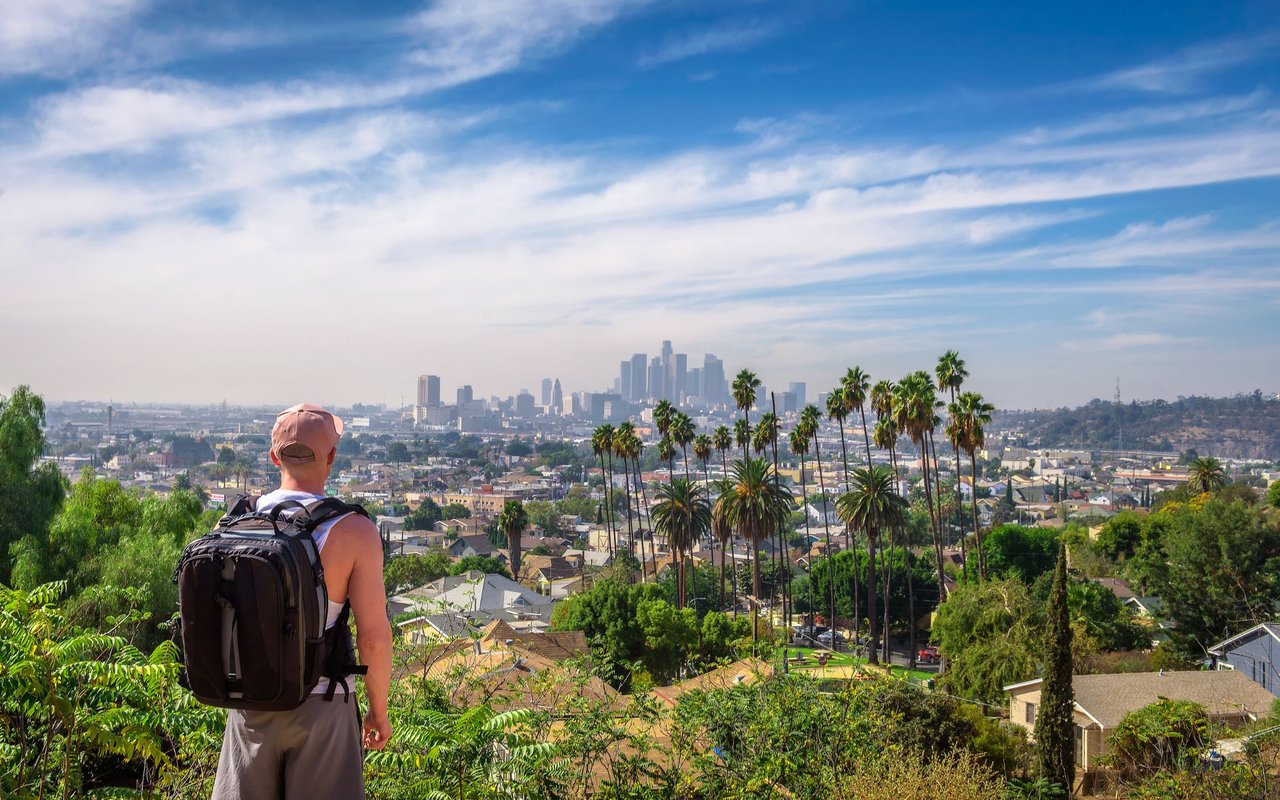
- Take in the views. The MRCA describes 360-degree views of the San Gabriel Mountains, the Whittier-Puente Hills, and downtown Los Angeles, along with pockets of native walnut woodland.
- Arrive at Test Plot near Lathrop Street. Test Plot gives 5009 Lathrop St. as its closest address and says street parking there is ample. That makes the east end the easier place to start if you'd rather begin at the garden.
Along the way, Save Elephant Hill's guide says walkers may see walnut trees and coffeeberry. The MRCA's nature guide for the site lists oak and elderberry trees, and wildlife including rabbits, coyotes, bobcats, owls, and hawks.
The MRCA's general rules allow dogs on a leash, kept under control and cleaned up after. That is the agency's policy for its parks overall. No sign rule specific to Elephant Hill turned up.
The garden at the end of the line
The trail's last stretch connects the hill as it is now to what it could become. Test Plot is an L.A.-based nonprofit that works to revitalize depleted land. The plant list for its Elephant Hill plot includes SoCal black walnut, coast live oak, coffeeberry, southern bush monkeyflower, California buckwheat, California fuchsia, and black sage, and notes that many of the trees were sown directly from seed or acorn. In an October 2025 article, the California Native Plant Society reported an estimate that the plot's established native planting has grown to nearly 20,000 square feet, with invasive mustard and horehound giving way to native species.
Yañez told LAist that at the end of the trail, hikers can see "exactly what a restored Elephant Hill would look like." Sarah Kevorkian, who oversees the trail project for the MRCA, described the opening the same way:
"We're wrapping up the trail, but it really feels like the beginning of all that is to come."
So the walk shows three stages one after another. First come the switchbacks on the land that's been acquired. Then come views over a hilltop that is still mostly private. The trail ends in a garden where native planting has already taken hold.
Twenty years of groundwork
None of this happened quickly. LAist reports that Save Elephant Hill has worked to preserve the land for two decades, and that illegal dumping and off-roading have damaged it over the years. The MRCA joined in 2018. The group started more than 15 years ago, after a successful effort to keep the hill from being developed. It now works with partners including the California Native Plant Society, Coyotl + Macehualli, Heroes of Elephant Hill, the Natural History Museum of Los Angeles County, the Resource Conservation District of the Santa Monica Mountains, and Test Plot.
The hill is also under study through the Safe Clean Water Program's Technical Resources Program. The feasibility study will look at nature-based ways to address water quality on the site.
Ways to get involved this season
Test Plot's volunteer calendar listed an Elephant Hill Workday on September 27, 2026, and the volunteer page is where future workdays appear. Save Elephant Hill says it has put together a series of public nature walks and an illustrated guide for 2026, with biologist Natasha Khanna-Dang and support from the Natural History Museum. Walk dates hadn't been posted yet, so the group's site is the place to check.
Closer to home on the calendar, El Sereno Community Arts holds its 17th annual Día de los Muertos Festival on Saturday, October 17, from 2 to 9 p.m. at 4721 Klamath St. The Los Angeles Times listing mentions mariachi, live music, communal altars, vendors, and family activities. A morning on the trail before the gate closes leaves the afternoon free for Klamath Street.
I've spent a lifetime looking at how land and light shape a place, and a hillside that comes into public hands one parcel at a time is something I always notice. If you walk Elephant Hill this fall and want to talk about El Sereno's hillside streets or the character of the homes along Pullman and Lathrop, Maureen Pearson would be glad to hear what you saw. Let's Connect.